
(Image courtesy of Chat GPT)
In recognition of Earth Day on April 22, 2026, let's do a thought experiment.
Imagine that you've been elected leader of Space Station E located in deep space. As the elected official, your mission will be to ensure the health and well-being of all the inhabitants. Your vision will be to safeguard the space station's long-term integrity and habitability. Eight million people, roughly the size of New York City, along with millions of other animals, plants and trees will be your responsibility on the space station, a gravity-generating blip in the universe.
To achieve these goals, the space station must guarantee, at a minimum, life's essentials including an optimum ambient temperature, air, food, and water.
The Goldilocks temperature zone for life ranges from 50 to 95 degrees Fahrenheit (10 to 35 degrees Celsius). Ideally, you'll maintain the temperature around 68 degrees F (20 degrees Celsius) to keep everyone happy and comfortable. If the temperature swings to freezing or boiling for extended periods, you risk having dead crops and animals, including humans. Don't take the temperature for granted and don't mess with the thermostat!
The air on Space Station E will be perfectly mixed with 78 percent nitrogen, 20.95 percent oxygen, 0.93 percent argon, 0.04 percent carbon dioxide, and a few other trace gases. You'll want to keep these percentages as close to baseline as possible. Too much of any of them could jeopardize the health of the system and the inhabitants. Monitors placed throughout the station will track gas levels and notify you if anything is off. Since the space station will be solar powered, gases from combustion engines will not be an issue. However, beware of deadly gases like methane, which could be a problem depending on which protein sources are used for food.
All proteins are not created equal. Some animals are more efficient at producing meat than others. (Think of fuel-efficient cars getting more miles per gallon than gas guzzlers.) Feed-efficient animals make more meat per feed eaten. The least feed-efficient animals are ruminants, particularly beef cattle. They require around 6 pounds of feed for every 1 pound of meat grown. Even worse, one chamber of their stomachs, called a rumen, ferments the feed and produces methane, a deadly gas, that they burp into the air. The more cattle, the more methane. The burps add up, causing serious hazards.
Unlike ruminants, broiler chickens, egg-laying hens, farmed fish like salmon, and insects such as crickets, mealworms, and grasshoppers are highly feed-efficient protein sources and don't produce methane. Broiler chickens need around 1.5 to 2 pounds of feed to produce 1 pound of meat. Farmed fish are more feed-efficient than poultry but require tanks which raise their own unique challenges. Insects are highly feed-efficient and produce very little waste, a big plus on a space station. Of course, the "ick" factor would have to be overcome, but anything can taste good if it's ground up, fried in olive oil, lightly salted, and splashed with balsamic vinegar.
Beans, legumes, tofu, peas, nuts, and seeds are the electric vehicles of protein production efficiency. They generate the cleanest and most sustainable proteins. Granted, vegetarianism or veganism might not be everyone's cup of tea but don't underestimate the power of peer pressure.
Almost half of the space station's habitable surface area will be used to produce food. Since fresh water supplies will be limited, it must be recycled for agricultural, industrial, and domestic use. It can't be contaminated by fecal waste.
The space station requires robust sanitation systems to process human and animal fecal waste. Eight million people and tens of millions of animals produce hundreds of thousands of tons of fecal waste. The waste must be processed to remove harmful microbes and recycled to be used as crop fertilizer. Jettisoning it into space isn't an option.
Painting a picture of Space Station E, you might imagine giant concentric rings with intersecting struts. But what if it were shaped like an enormous ball? What if the inhabitants lived on the surface rather than in the interior? What if the name "Space Station E" were replaced with "Planet Earth?" Would that change the mission and vision of elected officials responsible for the short-and-long-term habitability of our planet? It shouldn't.
Instead of 8 million humans, there are over 8 billion of us. There are over 30 billion domesticated terrestrial animals, including 1.6 billion cattle.
The thought processes that we used to imagine how we would maintain a space station's habitability apply to Earth as well. We don't want to mess with the thermostat. We don't want to pump deadly greenhouse gases like methane, nitrous oxide (largely from high nitrogen synthetic fertilizer), and carbon dioxide into the atmosphere. Eating feed-efficient proteins from non-methane producing animals and from plants helps reduce greenhouse gas emissions. Our oceans have been absorbing much of our greenhouse gas wastes. (They've also been serving as garbage dumps for our plastic wastes).
Eighty percent of the 4 billion tons of fecal waste produced annually by humans and their domesticated animals come from the animals. Sanitation systems, if they exist, only process human fecal wastes, not animal manure. These wastes contaminate crops, water, and environments contributing to disease. They also release greenhouse gases into the atmosphere.
Recent images of Earth by the Artemis II mission taken almost 54 years after the Apollo 17 mission in 1972 remind us of what's at stake. Earth is a tiny oasis in the vastness of the universe. We can't risk losing our only home.
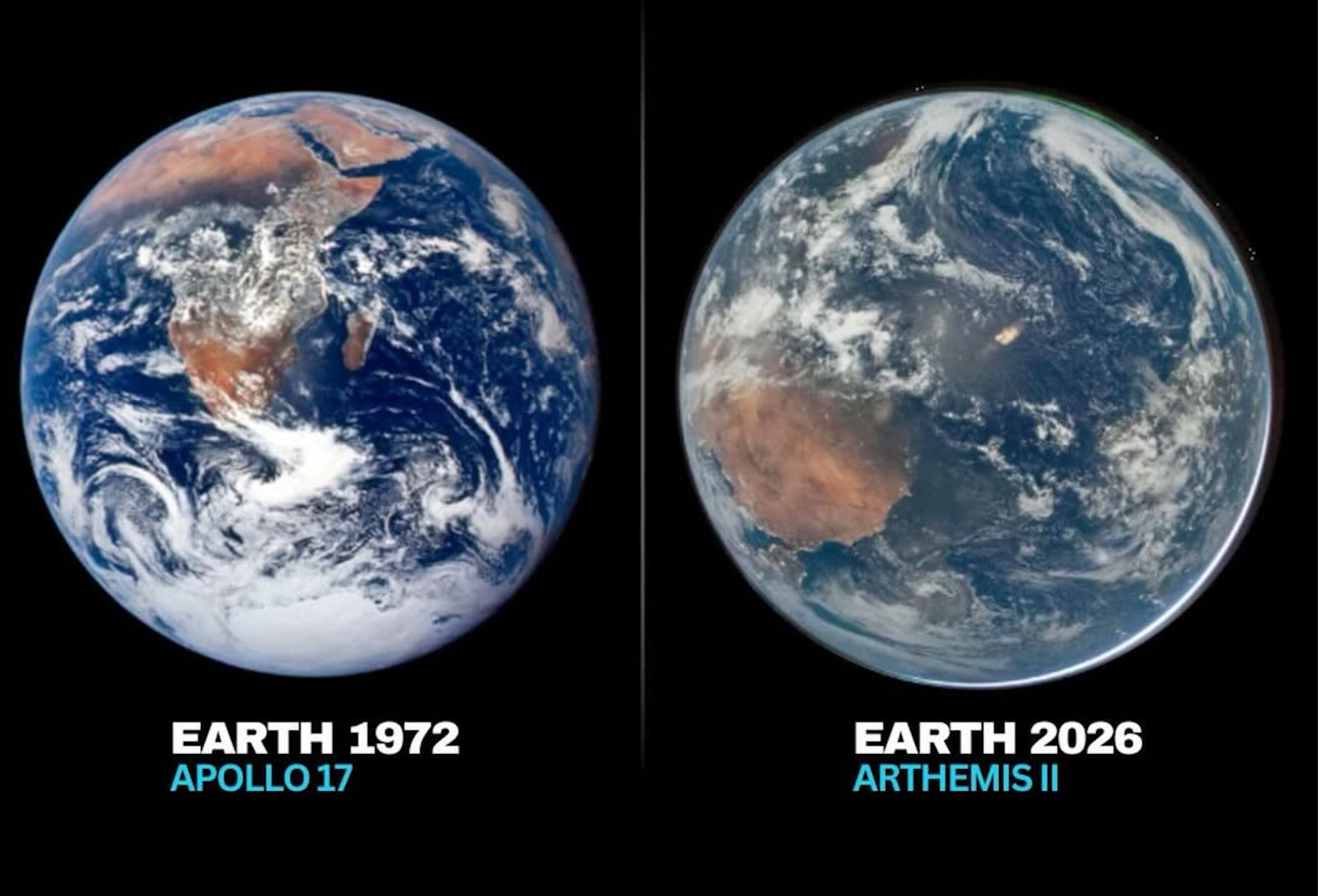
(Image courtesy of NASA)
We need to get our house in order. We need elected officials with knowledge, commitment, and compassion about the future of humanity, the future of other species, and the present and future habitability of our space station, Planet Earth.
There's no better time to get started than on Earth Day 2026.